Title & Ownership Documents in Karnataka: A Buyer's Guide

Owning property in Karnataka is not proved by one document. It is proved by a set of them, read together - the deed that transferred it to you, the deeds that transferred it before, and the records that show the government recognises you as the owner. Before you buy, you need to know what each document does and how they connect. Miss one link and you may be paying for a title that does not hold.
This guide walks through the main title and ownership documents in Karnataka, what each one means, and how they fit together - plus the Karnataka records and portals that back them up.
This is general information, not legal advice. Have the actual documents reviewed by a property lawyer before a purchase.
The core ownership documents
Sale Deed. The primary, legally operative document that transfers ownership for a price. It must be registered at the Sub-Registrar's office under the Registration Act, 1908. A registered sale deed is the main proof of ownership and the basis for future transfers and mutation. This is the document you ultimately rely on as "title."
Mother Deed. The earliest available document in a property's history - its root of title. It shows where ownership originally came from (a first sale, a government grant, a partition) before the property passed through later transactions. The mother deed anchors the whole chain; if it is missing, the history has to be rebuilt from revenue records.
Chain of Title. The unbroken sequence of every registered transfer - sale, gift, partition, inheritance, release - linking the mother deed to the current owner. Every link must be a valid, registered document. A break or a defective link (for example an invalid GPA "sale") can compromise the entire title. Buyers commonly trace this back 20 to 30 years.
Documents that transfer or divide ownership
Gift Deed. A voluntary transfer with no money changing hands, usually out of love and affection. For immovable property it must be registered to be valid. Common for transfers within a family.
Partition Deed. Divides jointly or co-owned property (typically among family members) into defined individual shares. It must be registered to be legally effective for immovable property.
Release Deed (Relinquishment). One co-owner formally gives up their existing share in a jointly owned property in favour of the other co-owners. The key point: the person releasing must already hold a share - unlike a gift, which can be to anyone. Common when siblings consolidate inherited property into one owner's name. Must be registered.
Rectification Deed. Corrects a genuine clerical or factual error (a misspelt name, a wrong survey number, a boundary misdescription) in an already-registered document. It fixes errors only - it cannot change ownership, price, or the nature of the transaction - and must be signed by the original parties and registered at the same Sub-Registrar office.
Will. Directs how a person's property is distributed after death. In Karnataka, registering a will is optional but recommended. Probate is generally not mandatory here, but Sub-Registrars and banks often ask for it before transferring or lending against inherited property, so in practice it is frequently needed.
Power of Attorney: GPA and SPA (not title documents)
A Power of Attorney authorises someone to act on the owner's behalf. It is not a title document and does not transfer ownership.
- A General Power of Attorney (GPA) grants broad authority across many acts.
- A Special Power of Attorney (SPA) is limited to one specific act, such as selling one named property.
The Supreme Court, in Suraj Lamp & Industries (2011), held plainly that a GPA, an agreement to sell, or a will-based arrangement does not convey title to immovable property. Only a registered sale deed does. So if a seller offers to transfer a property "on GPA," treat it as a warning sign - insist on a registered sale deed executed by the actual owner (or by an attorney acting strictly within a valid POA).
The Karnataka records that back up your title
Documents alone are not enough - they have to match the government's records. In Karnataka, that means:
- Kaveri Online Services (kaverionline.karnataka.gov.in) - the Department of Stamps and Registration portal for registering deeds, calculating stamp duty, and downloading the encumbrance certificate.
- Encumbrance Certificate (EC) - lists all registered transactions on a property over a period, showing whether it carries any loan, mortgage, or claim. Issued as Form 15 (transactions exist) or Form 16 (Nil EC).
- Khata / e-Aasthi - the municipal tax-and-ownership record. For urban property this is the e-Khata under e-Aasthi; for gram panchayat property it is Form 9 and Form 11 under e-Swathu. Khata is a revenue record, not proof of title on its own.
- RTC (Pahani) - for agricultural land, the record of rights maintained on Bhoomi; you can view it with our Karnataka land records tool.
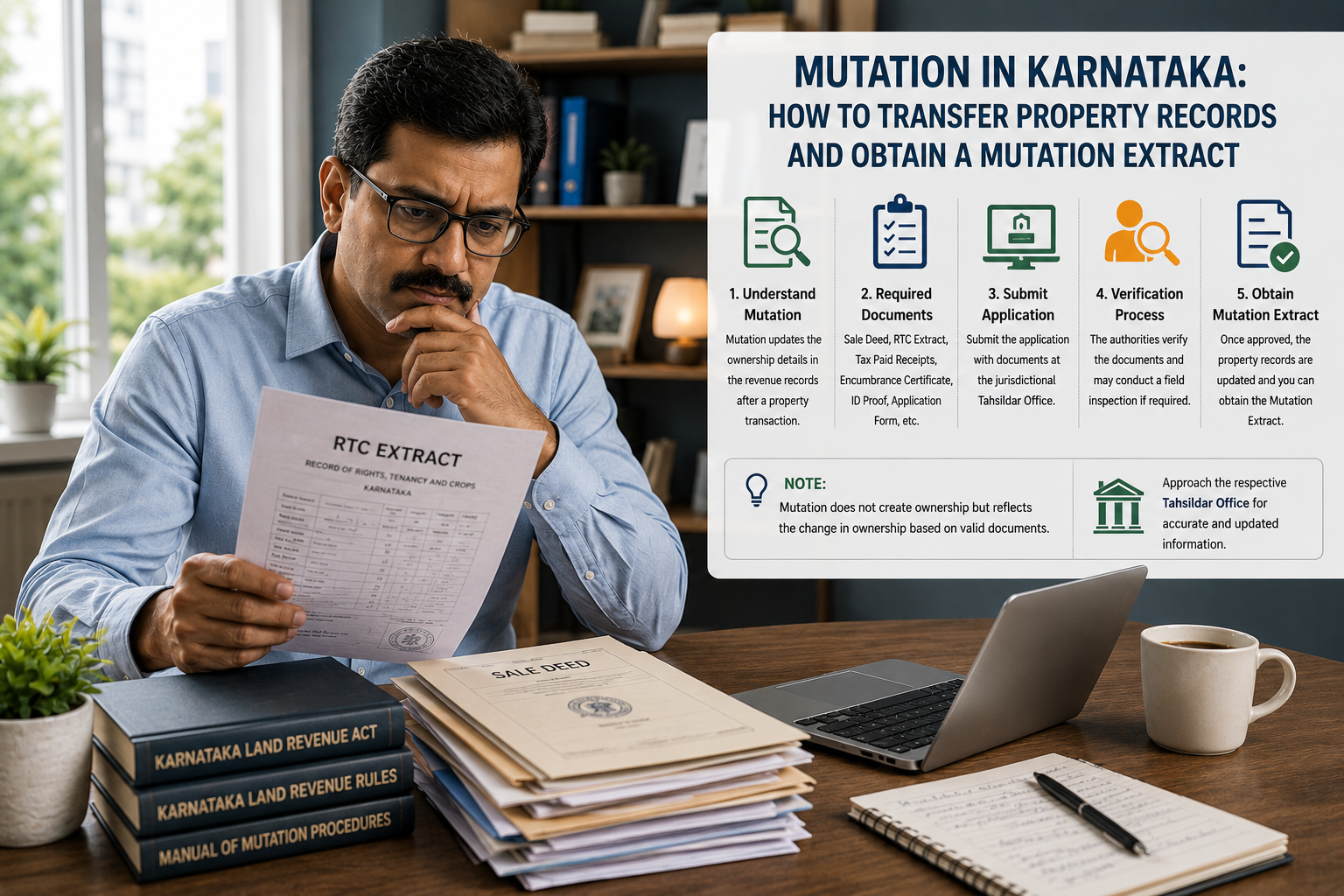
- Mutation - the update that puts the new owner's name into the revenue or khata record after a registered transfer. Track it with our e-Pouthi Karnataka guide.
Title is clean only when the deeds, the EC, the khata, and the mutation record all point to the same owner.
Frequently asked questions
Is a registered sale deed enough to prove I own the property? It is strong primary evidence, but not the whole story. Also verify the full chain of title from the mother deed, a clean EC, the khata/e-Aasthi updated in the seller's name, and mutation of the revenue record. A single deed alone does not guarantee clean title.
Can I buy from someone holding a GPA for the owner? A GPA alone does not transfer title. Insist that the actual registered owner - or an attorney acting strictly under a valid, specific POA - executes a registered sale deed. Do not rely on a GPA-only transaction as proof of ownership.
What is the difference between a release deed and a gift deed? A release deed is used when a co-owner gives up an existing share in jointly owned property to another co-owner. A gift deed can transfer property to anyone, including someone with no prior interest. Both must be registered.
There is a typo in my registered sale deed. Do I need a fresh deed? No. A rectification deed, registered at the same Sub-Registrar office with the original parties' consent, can correct genuine clerical or factual errors. It cannot be used to change ownership or the price.
How far back should the encumbrance certificate go? Sub-Registrar offices often work off a minimum 13-year EC, but for due diligence and home loans, 30 years (or as far back as records allow) is the safer practice.
The seller inherited the property. What extra should I check? Confirm whether a will exists and was probated where required, that all legal heirs have consented or relinquished their shares through registered release or partition deeds, and that the chain from the deceased owner to the seller is complete and registered.
The bottom line
In Karnataka, ownership is not one piece of paper - it is a chain of registered documents that must line up with the government's records. Read the deeds together, match them against the EC, khata, and mutation, and confirm every link back to the mother deed. If any link is missing or a "shortcut" like a GPA sale is on offer, slow down. If you want the whole set checked before you buy, talk to the TLB team.
Verify first. Pay later.
Want clarity and confidence about your land?
Try TLB for free and see where your land stands.
Try TLB for Free