Types of Land Records in Karnataka and Their Documents

Karnataka does not keep one kind of land record. It keeps three, because it has three broad kinds of property - agricultural land, gram panchayat (rural non-agricultural) property, and urban property - and each is recorded in a different system. Before you buy or verify a property, the first question is: which type is it? Get that right and you know exactly which documents to ask for and which portal to pull them from.
This guide maps the land records for each type of property in Karnataka, what each document proves, and where to get it.
1. Agricultural land - the Bhoomi records
Agricultural land is recorded by the Revenue Department in the Bhoomi system.
- RTC / Pahani (Form 16). The Record of Rights, Tenancy and Crops - the primary ownership document for agricultural land. It shows the owner, survey number, extent, soil type, the crop grown, tenancy, and land revenue. This is the record you read first for any farmland. You can pull it up with our Karnataka land records tool.
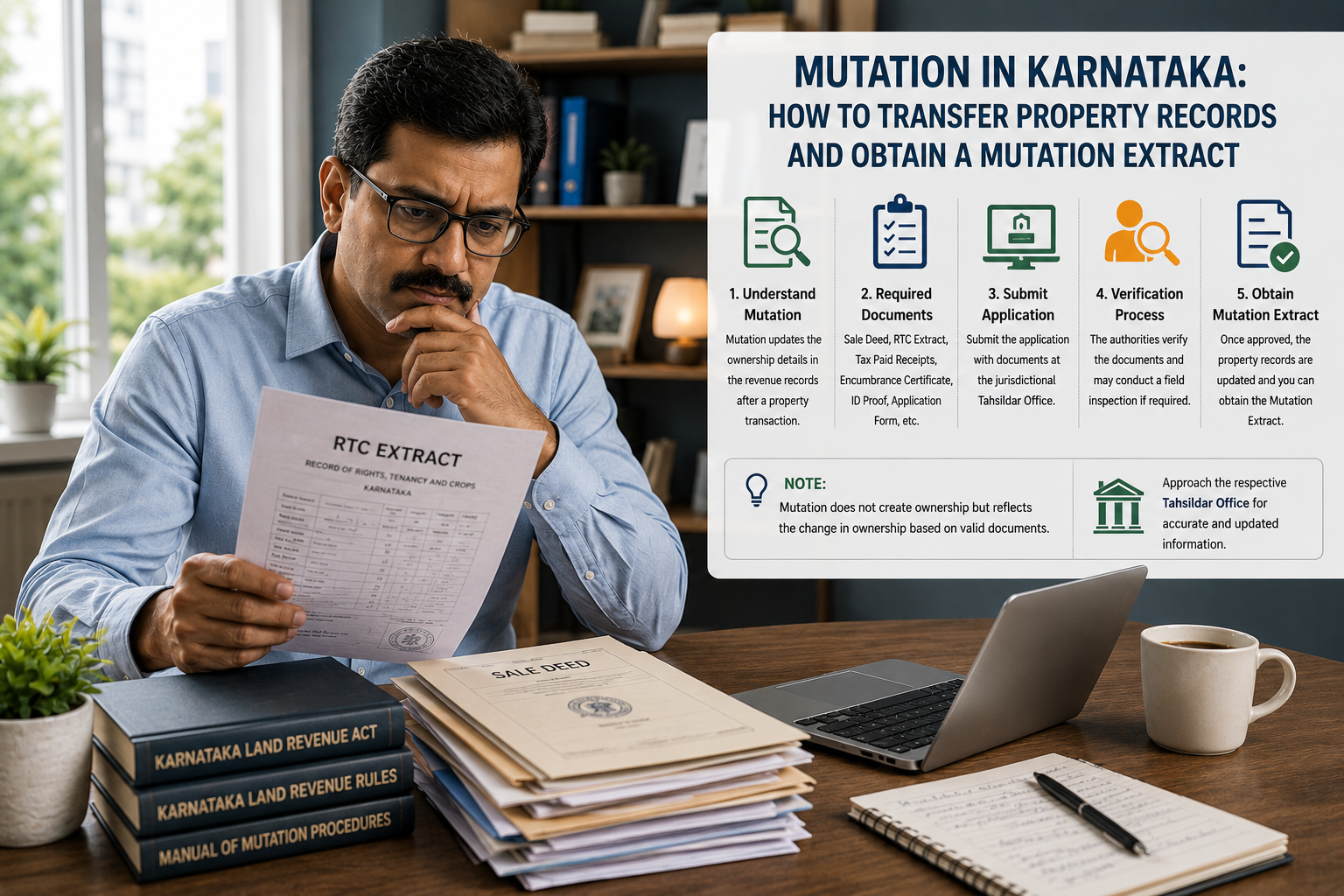
- Mutation Register (MR) extract. Records every change of ownership or rights - sale, inheritance, gift, partition, court order - with the old and new owners. It shows how the land came to the current owner. Our e-Pouthi Karnataka guide covers the mutation side.
- Tippani. The original field-survey sketch for a survey number - the base reference for boundaries.
- Akarband. A Survey Department record stating the total extent, classification (dry, wet, garden), cultivable versus kharab (non-cultivable) area, and assessed revenue.
- Podi extract. Shows how a survey number was split into sub-numbers (hissas) when land has been subdivided.
- Village map / survey sketch. Cadastral maps of survey boundaries, available via Bhoomi and the Dishaank GIS app.
Two things to check on agricultural land: whether it needs DC conversion before any non-agricultural use (sanctioned by the Deputy Commissioner under the Karnataka Land Revenue Act), and whether it is granted land under the PTCL Act - land originally granted to an SC/ST person, which cannot be freely transferred and can be reclaimed even from an innocent buyer. Both are title risks worth confirming, and the rules around who can buy agricultural land change from time to time, so verify the current position.
2. Gram panchayat property - the e-Swathu records
Rural, non-agricultural property inside a gram panchayat is recorded on e-Swathu.
- Form 9. The property register extract that certifies a legal non-agricultural property within gram panchayat limits - issued only after conversion, plan sanction, and verification.
- Form 11. The demand and collection register showing the property tax record and mutation history. (The newer e-Swathu also issues an updated tax record referred to as Form 11B - confirm the current form on the portal.)
- Rural e-Khata. The digital combination of Form 9 and Form 11, confirming the property is panchayat-registered, tax-assessed, and attributed to its owner.
We cover these in detail in our guide to e-Swathu Form 9 and Form 11. No valid Form 9 is a serious red flag on a gram panchayat property.
3. Urban property - the e-Aasthi / khata records
Urban property under a municipal body (in Bengaluru, BBMP / GBA) is recorded through khata and the e-Aasthi system.
- Khata Certificate and Khata Extract. The municipal record confirming the property is in the assessment register; the certificate is needed for registration and utility connections, the extract shows property details and tax history.
- e-Khata / e-Aasthi. The official digital property record, tied to a unique Property ID (PID). A valid e-Khata is now checked at the time of registration.
- A-Khata vs B-Khata. A-Khata means the property complies with building bye-laws and can get plan approvals and loans. B-Khata flags an irregularity (unconverted land, unapproved layout) and generally cannot - and digitising a B-Khata into an e-Khata does not upgrade it. This distinction matters a lot before you buy.
- Property tax paid receipts. Proof the municipal tax is current - checked during due diligence and required for khata issuance.
Which portal for which record
| Portal | What you get |
|---|---|
| Bhoomi | RTC / Pahani, mutation, survey records (agricultural land) |
| e-Swathu | Form 9, Form 11, rural e-Khata (gram panchayat property) |
| e-Aasthi | Urban khata / e-Khata, PID, property tax (BBMP / GBA) |
| Kaveri Online | Registration, encumbrance certificate (EC), stamp duty |
| Dishaank | GPS-based cadastral / survey maps |
The documents that apply to every property
Whatever the type, a few records cut across all three:
- Sale Deed - the registered instrument that transfers ownership.
- Encumbrance Certificate (EC) - shows whether the property carries a loan, mortgage, or claim; from Kaveri Online.
- Khata - the tax/revenue record (RTC-linked for agricultural, Form 9/11 for panchayat, A/B khata for urban).
- Mutation - the update reflecting the new owner after a registered transfer.
None of these proves ownership on its own. Title is clear only when the deed, the EC, the right khata, and the mutation record all agree.
The bottom line
The first step in verifying any Karnataka property is knowing which of the three it is - agricultural, gram panchayat, or urban - because that decides which records prove ownership. Pull the right document from the right portal, read it alongside the sale deed and EC, and you will spot most problems before they cost you. If you would rather have the full set checked for a specific property, talk to the TLB team.
Verify first. Pay later.
Want clarity and confidence about your land?
Try TLB for free and see where your land stands.
Try TLB for Free