Mutation in Karnataka: Transfer Records & Get a Mutation Extract
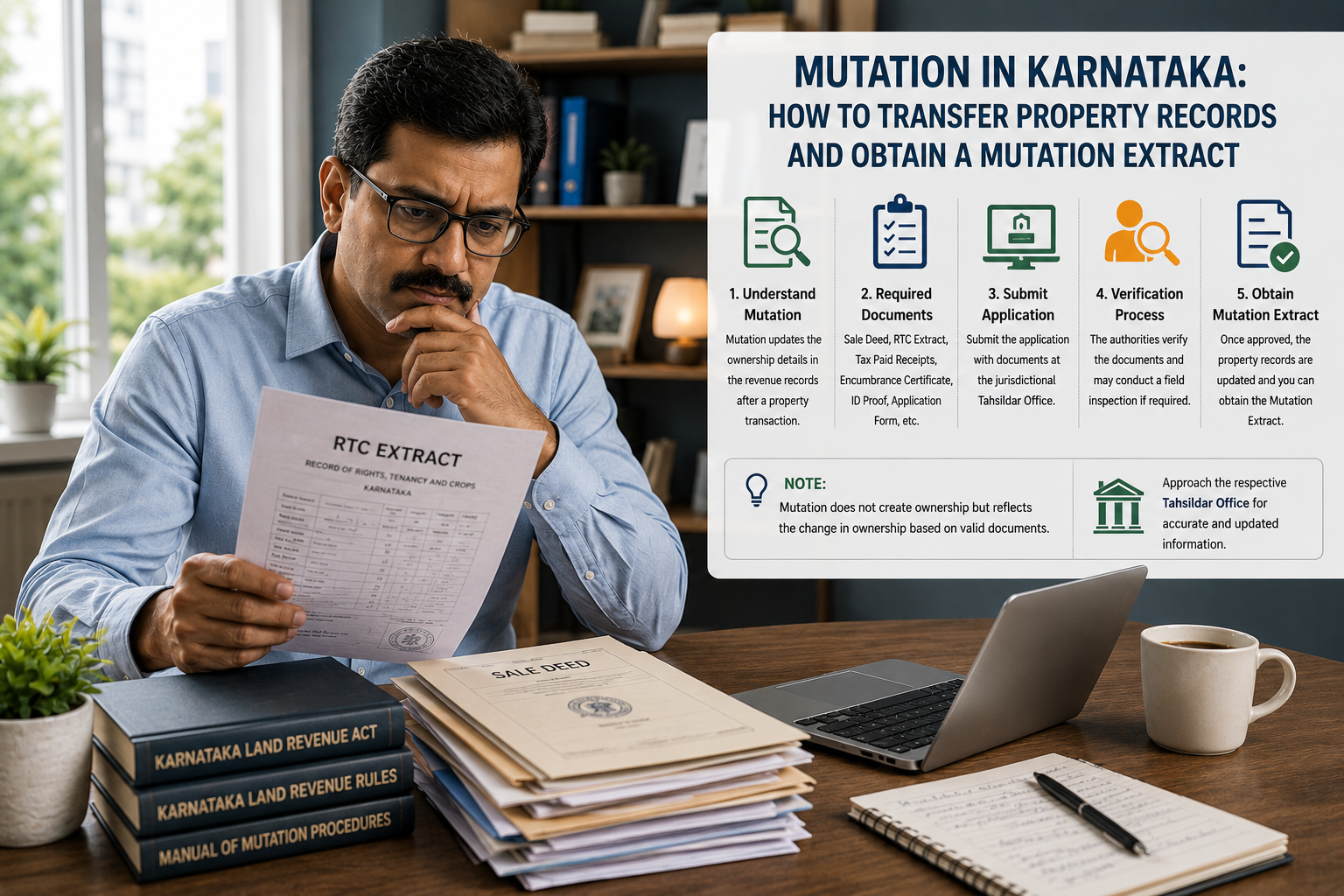
When you buy property in Karnataka, registering the sale deed is only half the job. The registered deed transfers the title to you - but the government's records still show the previous owner until a second step is done: mutation. Until mutation is complete, the RTC or khata carries the seller's name, not yours. This guide explains what mutation and a mutation extract are, why they matter, and how to get your records updated.
What is mutation, and what is a mutation extract?
Mutation (in Kannada, Hakku Badlavane) is the process of updating the government's revenue or civic records to reflect a change of ownership - after a sale, inheritance, gift, partition, or court order.
The Mutation Extract (or Mutation Register, MR) is the official record of that change. It shows the mutation number, the survey number or hissa, the previous and new owner names, the basis of the transfer, the date, and any remarks or restrictions.
One critical point: mutation updates the fiscal record (who is liable for tax and shown as owner in revenue records). It is not proof of title on its own. Courts have repeatedly held that a registered sale deed and a lawful chain of title prevail over a mutation entry. So mutation matters - but it sits alongside your title documents, it does not replace them.
Why mutation matters
- It puts property tax and land revenue liability in your name.
- It is the evidence that revenue records reflect the current owner - which banks check before a loan and buyers check before a purchase.
- Without it, the RTC or khata keeps showing the seller even after a valid registered sale, which causes problems when you later sell or borrow against the property.
Two contexts in Karnataka
Mutation works differently depending on the type of property.
Agricultural land - Bhoomi
For agricultural land, mutation happens in the Bhoomi system, maintained by the Revenue Department under the Tahsildar.
- Registration is linked to Bhoomi through a J-slip, so a registered sale deed can trigger the record update automatically.
- Since 2024, Karnataka has moved to auto-mutation: many registered sale deeds auto-update the Bhoomi RTC within about 15 days, and cases that need no field verification (such as bank mortgages and certain court orders) can be fast-tracked to around 24 hours.
- Standard or contested cases still follow the older route: a Revenue Inspector verifies in the field, a public objection/notice period runs, and the Tahsildar approves - which can take up to about 90 days.
A common silent failure: the J-slip gets rejected because of a name spelling or survey-number mismatch between the registration and Bhoomi systems, and no one tells the buyer. That is why you should check your RTC after a purchase rather than assume it updated.
Urban and gram panchayat property - khata transfer
For property inside a city or town, mutation takes the form of a khata transfer:
- BBMP / GBA (city) property - done on the e-Aasthi portal as a khata transfer, updating the municipal assessment record.
- Gram panchayat property - handled through e-Swathu, where the ownership change is reflected in Form 11 (with Form 9 certifying the property).
How to apply
For agricultural land (Bhoomi):
Step 1 - Let the J-slip trigger it. After the sale deed is registered, the J-slip routes the mutation to the Revenue Inspector / Tahsildar for verification and approval.
Step 2 - Or apply offline. If it does not update, apply at the Taluk office or a Nadakacheri (Atalji Janasnehi Kendra) with a written application, the registered sale deed, and the existing RTC.
Step 3 - Follow up. Check the RTC within about 30 days and chase any rejection.
For urban khata transfer (e-Aasthi):
Step 1 - Log in. Sign in to the e-Aasthi portal with your mobile OTP.
Step 2 - Enter the property. Provide the PID (from the sale deed or previous khata).
Step 3 - Upload documents. Attach the sale deed, EC, previous khata, tax receipt, and ID.
Step 4 - Pay and verify. Pay the fee; the application goes through field verification before the new khata is issued.
Documents you will typically need
- Registered sale deed
- Previous RTC (agricultural) or previous khata (urban)
- Encumbrance Certificate (EC)
- Latest property tax paid receipts
- ID proof (Aadhaar / PAN)
- For inheritance: death certificate plus a legal heirship certificate, or a succession certificate / probate for larger or contested estates
Fees and timelines
Fees are modest but vary by property type and are revised from time to time - agricultural mutation is nominal, while urban khata transfer is commonly charged as a small percentage of stamp duty with a minimum fee. Because the exact figures differ across sources, confirm the current fee on the Bhoomi or e-Aasthi portal. On timelines, budget up to about 90 days for a standard agricultural mutation (less for the 2024 auto-mutation cases), and roughly 15 to 45 days for a clean urban khata transfer.
How to get your mutation extract
Step 1 - Go to the Bhoomi portal (landrecords.karnataka.gov.in).
Step 2 - Select District, Taluk, Hobli, Village, and the Survey Number.
Step 3 - Open "View RTC and MR," go to the MR tab, and fetch the details to view or download.
You can also get a certified copy at the Taluk office or Nadakacheri counter. For agricultural land, you can pull the RTC with our Karnataka land records tool, and our e-Pouthi Karnataka guide walks through the khata-transfer side.
Frequently asked questions
Does mutation prove I own the property? No. Mutation updates the revenue and tax record; your ownership is proved by the registered sale deed and the chain of title. Read them together.
Is mutation mandatory after buying land in Karnataka? With auto-mutation since 2024, a separate application is often not needed for a straightforward sale - but you must still verify the RTC or khata now shows your name, and follow up if it does not.
How soon should I check mutation status after registration? Within about 30 days, so you catch a rejected J-slip early.
The seller's name still shows after 90 days. What now? Follow up at the Tahsildar / Nadakacheri office (agricultural) or the e-Aasthi / BBMP ward help desk (urban). A name or survey-number mismatch is the usual cause.
Is khata transfer the same as mutation? Yes - khata transfer is the urban equivalent of mutation. "Mutation" is the general revenue-law term used for agricultural land and across India.
The bottom line
Mutation is the step that makes the government's records agree with your sale deed. Registering the property is not enough - confirm the RTC or khata is updated into your name, keep the mutation extract, and read it alongside your title documents. If your record still shows the previous owner, or you want it checked before a purchase, talk to the TLB team.
Verify first. Pay later.
Want clarity and confidence about your land?
Try TLB for free and see where your land stands.
Try TLB for Free