Survey Number Sub-Division (Podi) in Karnataka: How to Apply
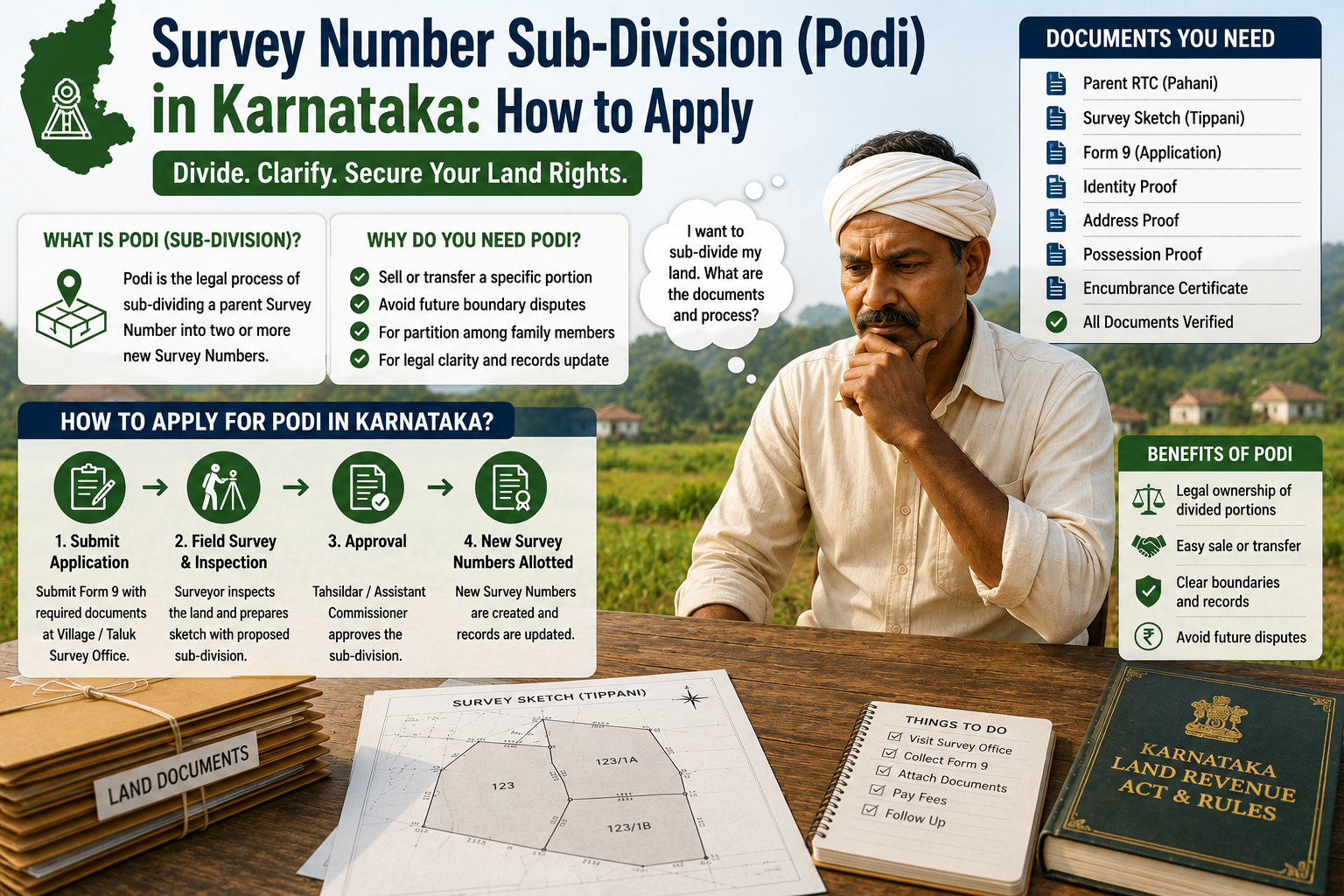
If you are selling a part of a survey number, splitting inherited land among heirs, or carving a plot out of a larger parcel in Karnataka, you cannot just draw a line on paper. The survey number has to be officially sub-divided - a process called Podi (also spelt Phodi) - and a survey sketch called the 11E has to be issued before the Sub-Registrar will register any partial transfer. Skip it and your sale stalls at the registration counter.
This guide explains what Podi is, when you need it, the documents and fees involved, how to apply online through Mojini or offline at the survey office, and the common issues that trip people up.
What is Podi (survey sub-division)?
Karnataka identifies land in three parts: the survey number, a surnoc (a division within it), and a hissa (the smallest sub-division). Podi is the official process of splitting one survey number into separate hissas, each with its own boundary, area, and owner.
For example, Survey No. 45 might be divided into 45/1, 45/2, and 45/3 - three distinct hissas, each a separate parcel on the record. That hissa creation is what a Podi application produces.
What is the 11E sketch, and why it matters
The 11E sketch is the official survey map issued by the Revenue / Survey Department that marks the exact boundaries of the sub-divided parcels. It is the document Karnataka law requires before a partial sale within a survey number can be registered. Without a valid 11E sketch, the Sub-Registrar cannot register the transfer of a portion of a survey number.
So the 11E is not optional paperwork - it is the gate. Any time only part of a survey number is being sold or partitioned, the 11E comes first.
When you need a Podi / 11E sketch
- Selling part of a survey number - carving one plot out of a larger holding.
- Partition among heirs or co-owners - splitting jointly held land into individual shares.
- After inheritance - separating a deceased owner's land among legal heirs.
- Layout or development - dividing land into multiple plots.
If the whole survey number is being sold to one buyer as-is, you generally do not need a Podi - it is required when the parcel is being split.
Who can apply
The registered owner (or owners) of the land, or their authorised representative, can apply. Where the land is jointly owned or being partitioned, the consent of all co-owners is usually required, so all parties should be aligned before you start.
Documents you will typically need
Requirements vary by taluk and case, but you should be ready with:
- RTC (Pahani) for the survey number - you can pull it up with our Karnataka land records tool.
- Proof of ownership - the registered sale deed or title document.
- Mutation extract (MR) showing the current owner.
- Consent letters from co-owners, where the land is jointly held or being partitioned.
- Identity proof (Aadhaar) of the applicant.
- Any partition deed or court order, if the split follows one.
Confirm the exact list for your taluk before applying, as it can differ.
How to apply online (Mojini)
Karnataka runs land survey and sub-division services through Mojini, managed by the Department of Survey, Settlement and Land Records (SSLR).
Step 1 - Open Mojini services. Go to the Bhoomi portal and find the Mojini / Survey (SSLR) services section.
Step 2 - Select the location. Choose your District, Taluk, Hobli, and Village.
Step 3 - Choose the survey type. Select the sub-division / partition (phodi) service.
Step 4 - Upload documents. Attach the RTC, ownership proof, and consent letters where applicable.
Step 5 - Pay the fee. Pay the applicable survey fee online (it varies with plot size and survey type).
Step 6 - Note the application number. Save the application number you receive - you will use it to track the progress and, later, to view or download the 11E sketch.
How to apply offline
You can also apply at the Taluk Survey Office or through a Nadakacheri (Atalji Janasnehi Kendra). Submit the application with the same set of documents and pay the fee at the counter. This is the route many people use when the record is not fully digitised or when there is an objection to raise.
What happens after you apply
- A licensed surveyor is assigned and visits the site to take GPS-based measurements.
- The surveyor prepares a draft sketch and submits it to the Assistant Director of Land Records (ADLR) for verification.
- Once verified, the department issues the digitally prepared 11E sketch.
- The sub-division is then reflected as new hissa numbers in the record, and mutation updates ownership of each new parcel. You can track the mutation side with our e-Pouthi Karnataka guide.
Fees
The survey fee is not a flat amount - it depends on the plot size and the type of survey, and is paid when you submit the application. Because rates are revised from time to time, check the current fee on the Mojini portal or at your taluk survey office rather than relying on an old figure.
Common issues (and how to avoid them)
- Co-owner disputes. A partition stalls fast if all co-owners have not consented. Get written consent up front.
- Boundary mismatches. If the measured boundary does not match neighbours' records, the survey can be objected to. Have your Tippani and neighbouring RTCs ready.
- Old or unclear records. If the RTC, mutation, and deed do not agree, sort that out before applying - the surveyor works off the record.
- Trying to register a partial sale without the 11E. The Sub-Registrar will refuse. Complete the Podi first.
- Wrong survey type selected. Choosing the wrong Mojini service delays everything; pick the sub-division / phodi option.
Practical tips
- Verify the RTC, mutation, and title all show the same owner before you apply.
- Line up co-owner consent in writing early.
- Keep the application number safe and track status online.
- Budget time - a site survey and ADLR verification take a while, so start well before you plan to register a sale.
Frequently asked questions
Is an 11E sketch mandatory to sell part of my land? Yes. For a partial sale within a survey number, the Sub-Registrar requires a valid 11E sketch before registering the transfer.
What is the difference between Podi and mutation? Podi sub-divides the survey number into new hissas and produces the 11E sketch. Mutation then updates the ownership record for each new parcel. They are separate steps - Podi first, then mutation.
Can I do the whole process online? You can apply and pay online through Mojini and track the application, but a physical site survey by a licensed surveyor is still part of the process.
How long does it take? It varies by taluk and the complexity of the case, since it involves a site visit and departmental verification. Start early rather than close to a planned sale date.
Do all co-owners need to agree? For a partition or a split of jointly held land, yes - consent of the co-owners is generally required.
The bottom line
Sub-dividing a survey number in Karnataka is a defined process: apply for Podi, get the site surveyed, and obtain the 11E sketch before any partial sale or partition can be registered. Get the records clean and the co-owners aligned first, and it goes smoothly. If you want the records checked or the split verified before you start, talk to the TLB team - we verify Karnataka land end to end.
Verify first. Divide later.
Want clarity and confidence about your land?
Try TLB for free and see where your land stands.
Try TLB for Free